The Solution
Don't forget to, like, subscribe!

On Monday, at the end of what I’ve been told is called a “Call to Action,” I included an exercise for the readers. Remember this bad boi?
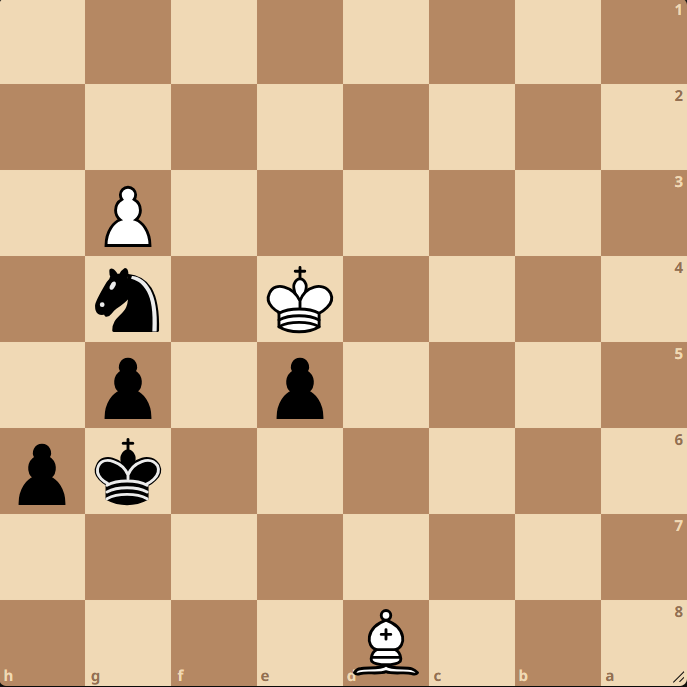
Today, I’m going to walk through how Black could have won from here in Chasin – Droin, Florianópolis, 2024 (International World Youth Championship).
This is the kind of solution and explanation you can expect on a weekly basis if you subscribe to Chess Puzzles.
I’ll just put the solutions in an unlisted Lichess study each week, though, rather than write out all the text on here. But, content-wise, this is what you can expect.
Oh and I forgot to put the new logo on Monday’s post before it went live, so in case you missed it:

Solution
Black’s only winning move is 59. … Kg7!!. This move does three things wrong. First, it goes backwards with the king. Second, it allows White’s king to infiltrate with Ke4-f5. Finally, it fails to over-protect the e5-pawn (preparing … Ng4-f6+ and the … e5-e4 push).
For these reasons, I’d be surprised (and concerned, and perhaps even suspicious) if this was on anybody’s first list of candidate moves. So, rather than explain why this move is right, I’m going to start with explaining what’s wrong with the move played in the game: 59. … h5?.
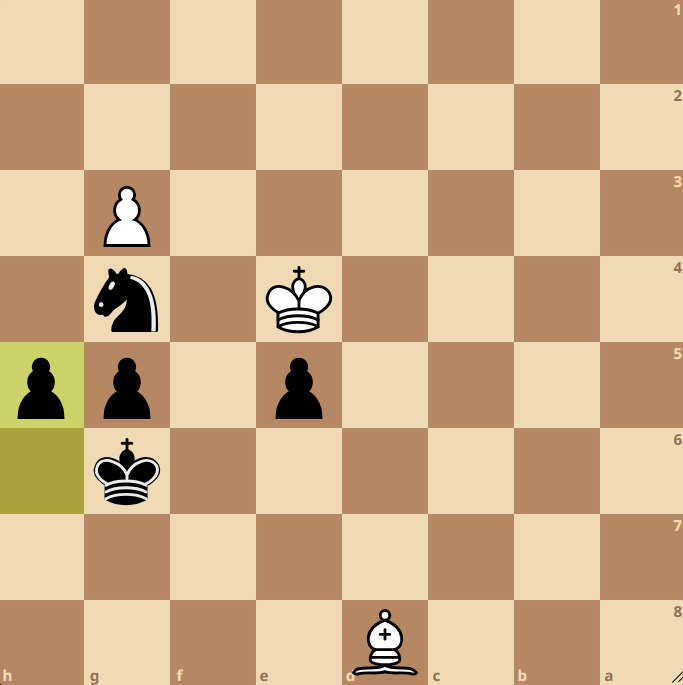
Black played 59. … h5? and won after 60. Be7?. The reason why White is now lost is their g-pawn dropped in the game after 60. … Nf2+ 61. Kf3 Nd1 62. Ke4 Nc3+ (see diagram):
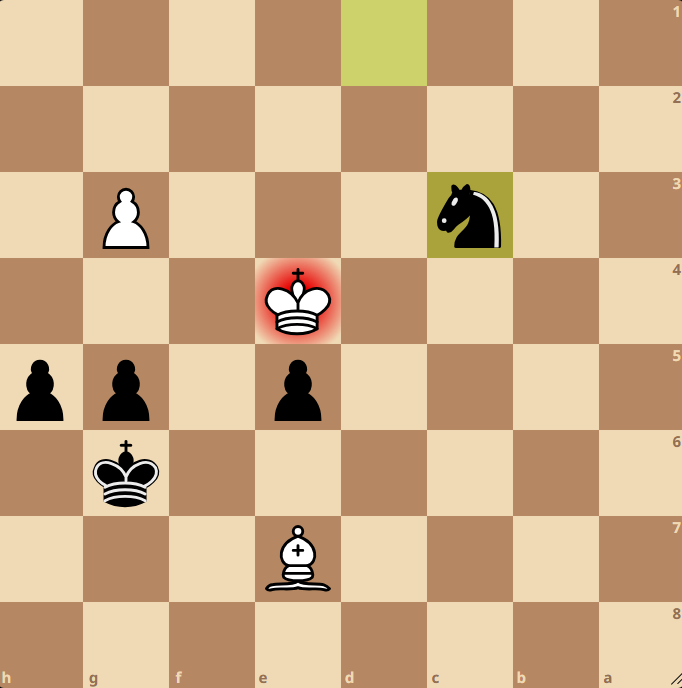
when the game ended after 63. Kxe5 Ne2!. There is no way for White to save the g-pawn. With connected passers, Black should be able to win.
Before moving on, what have we learned? Well, Black’s winning strategy is to win the g3-pawn by force. With White’s king on the e5-square, there is no way the bishop can defend the g3-pawn on the h2-b8 diagonal. So, our schema is: attack the g3-pawn once White has taken on e5.
Given this, the reason why 60. Be7? was wrong should be clear. Let’s look instead at the proper reply to 59. … h5?, which is 60. Bc7! (see diagram):
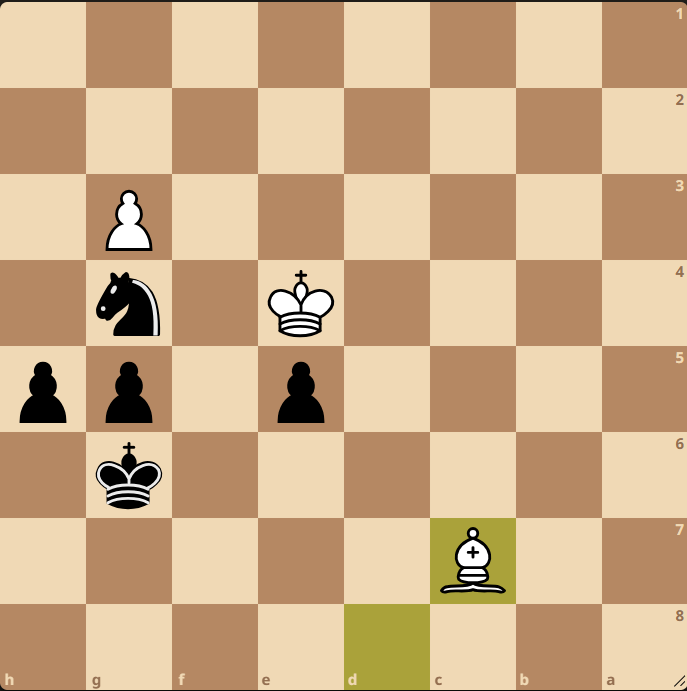
Black cannot play ... Ng4-f2+-h1 to win the g3-pawn due to Bc7xe5, but 60. … Kf6, to over-protect the e5-pawn, fails to 61. Bd8+! when Black must return to the g6-square, as the g5-pawn hangs otherwise.
In other words: Black wanted to advance the g- and h-pawns, taking the g3-pawn when White’s bishop could not defend it. Therefore, White’s bishop needed to stay on the e5-pawn, as to not obstruct the h2-b8 diagonal with the king.
Something else we’ve learned, which we can add to our schema: pushing … h6-h5 makes the g-pawn weaker. We can also add that we would like to be able to block Bd8 with … Ne4-f6, which here wasn’t possible when our king was on the f6-square, hence why we had to return to the g6-square.
Note 60. Ba5, with the idea of defending the g3-pawn passively, would also hold, but it would be trickier.
Okay, so, now let’s go back to the original position and see why 59. … Kg7!! is an improvement.
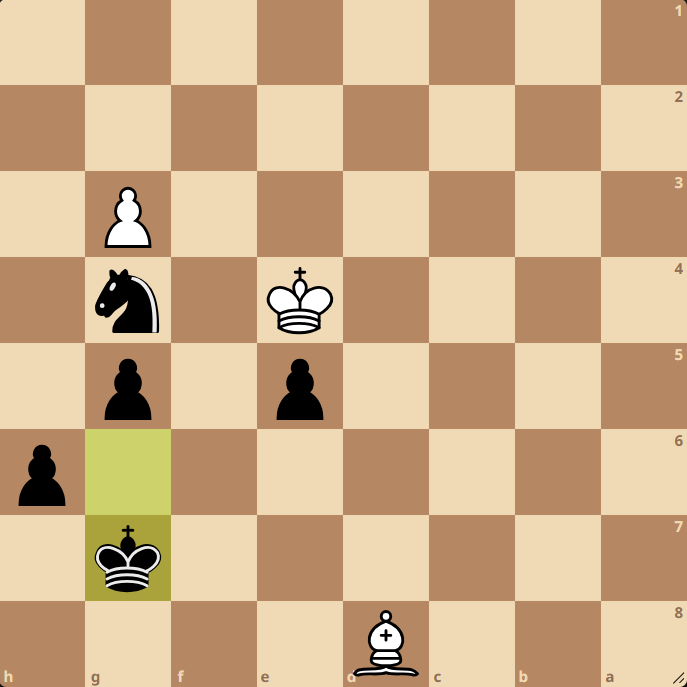
First, behold the freedom of Black’s king to step away from the g5-pawn. This is a waiting move: We’ll push … h6-h5 after the bishop leaves the h4-d8 diagonal. So, must the bishop leave the diagonal? If 60. Be7 Kf7 61. Kd8 Ke6!, we’ve weaseled our way to the defense of the e5-pawn, and now win with … Ng4-f6+, … Ke6-f5, and forward motion.
But if the bishop does leave the h4-d8 diagonal, say with 60. Bc7, then 60. … Kf6 61. Bd8+ Ke6 is exactly the same.
So, now we only have to look at king moves, and 60. Kf3 is much too passive allowing … Ne4-f6 right away without losing the e5-pawn. So, finally, let’s look at 60. Kf5.
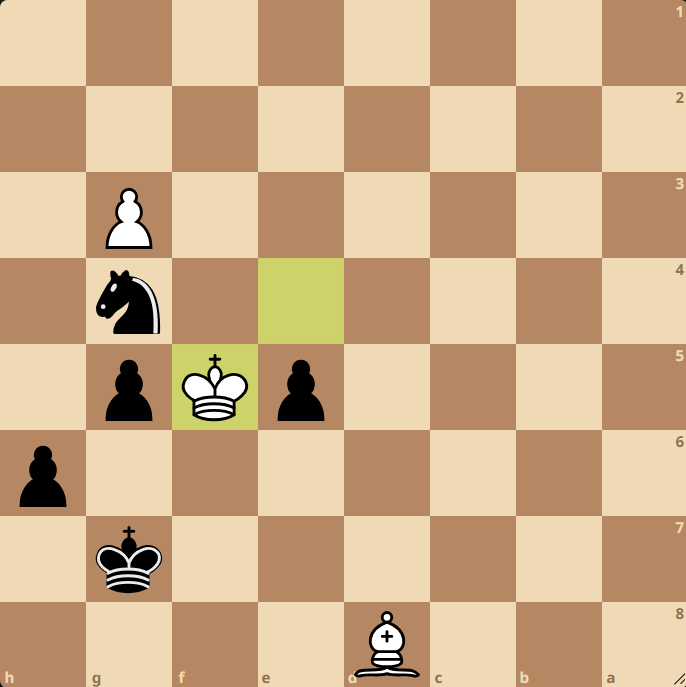
Now, as we already know from our schema, we are happy to chuck the e5-pawn if it means White has to obstruct the h2-b8 diagonal. So, we continue 60. … Ne3+ 61. Kxe5 Nf1 62. g4 (see diagram):
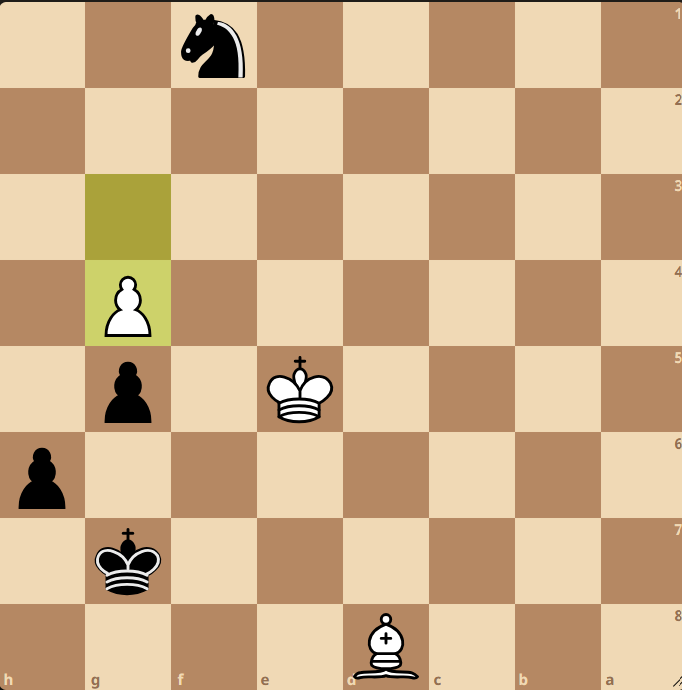
when Black wins with 62. … Kg6!. The white king will never be able to defend the g-pawn now, and the g-pawn is on the wrong-colored square to get help from the bishop. If there’s only one motif you remember from this exercise, I hope it’s this barrier.
But, if you’re open to learning more than one thing, do you see how we started with an abstract plan (win the g3-pawn) and finessed it (make sure they take with the king on e5, not the bishop) until it worked? I don’t expect all of you (or any of me) to have solved this over the board. But being able to make these connections is how we improve at endgames, and if we can put the work into trying to solve positions like this, we’ll learn where our holes are in our thinking.
As a bonus, shout out in the comments if you see why 59. … Kf7?, with the same idea as our winning line, does not also work.
I’m sorry,
JJ
When you first posted this I set this up vs stockfish 8 on Lichess where it would beat me easily on the black side but I kept drawing when i tried to beat it. I gave it a few tries and then settled back to wait for today's post. Which after getting the theme I was finally able to beat our silicone friend.
Nice puzzle! It's also good calculation practice to figure out why 62...Ne3 right away doesn't work.